The Universal White Brotherhood is an esoteric spiritual teaching founded by the Teacher Petar Danov in Bulgaria. It is not a religion, but a system of principles and practices for spiritual development, the best-known of which is paneurhythmy.
- Its founder, Petar Dаnov, was a Bulgarian spiritual teacher who developed the teaching in the early 20th century.
- Paneurhythmy is a central practice that combines music, movement and meditation, performed outdoors in nature.
- The teaching is based on three main principles: Love, Wisdom and Truth, which guide the lives of its followers.
- The movement has no strict hierarchy or formal membership, setting it apart from traditional religious institutions.
- The largest event is the annual summer gathering near the Seven Rila Lakes, which attracts followers from around the world.
The Universal White Brotherhood is more than a historical phenomenon. It is a living system of practices centred on paneurhythmy. Performing it properly requires specific conditions: it takes place early in the morning, outdoors in nature, between 22 March and 22 September. The best-known place to practise it is the Seven Rila Lakes.
For Bulgarians in 2026, the teaching represents a unique part of the country’s intangible cultural heritage that is attracting renewed interest. The annual gathering in the Rila Mountains has become an event that draws not only followers, but also people looking for a spiritual alternative and a closer connection with nature, away from the dogmas of organised religion.
The movement’s lasting appeal lies in its focus on individual practice and personal experience rather than blindly following dogma. This flexibility has allowed the Universal White Brotherhood to survive and develop for more than a century, adapting to the modern world.

Who Is the Teacher Petar Danov?
Why Is Petar Danov Called “the Teacher”?
Petar Danov is called “the Teacher” because his followers see him not simply as a lecturer, but as a spiritual guide who offers knowledge and methods for personal growth and a connection with the divine.
The Teacher Petar Danov (1864–1944) was a Bulgarian philosopher, spiritual leader and founder of the Universal White Brotherhood. He was born in the village of Hadarcha (now Nikolaevka, in the Varna region) into the family of a Bulgarian National Revival priest. He received a solid education and went on to study theology and medicine in the United States. According to the official information, he was born on 11 July 1864.
After returning to Bulgaria in the late 19th century, he began giving talks and gathering a circle of students who shared his views. His teaching is syncretic, combining elements of Christian mysticism, Eastern philosophies and his own insights into the relationship between humanity, nature and the cosmos.
His main aim was not to establish a new religion, but to offer a practical system for spiritual growth. That is why he focused on methods such as prayer, music, breathing exercises and paneurhythmy, using them as tools for achieving inner harmony.
What Are the Main Principles of the Teaching?
What Is the Difference Between Danovism and the Universal White Brotherhood?
“Universal White Brotherhood” is the official name of the spiritual community and its teaching. “Danovism” is a popular but unofficial term used as a simpler way to refer to the movement associated with its founder, Petar Danov.
One of the most common mistakes is to view the teaching as a conventional religion with strict dogmas and obligatory rituals. In fact, it is a spiritual school that emphasises personal development. Three fundamental principles guide its followers through life: Love as the foundation of everything, Wisdom as the light that shows the way, and Truth as absolute freedom.
These principles are not abstract ideas; they are meant to be applied in everyday life. For example, Love is expressed through one’s attitude towards all living things and nature. Followers are often vegetarian and strive to live in harmony with their surroundings. Wisdom is sought through the study of natural laws and divine truths, not simply by reading books.
Key symbol: An equilateral triangle representing the three principles: Love, Wisdom and Truth.
Key text: “The Testament of the Colour Rays of Light”, given by the Teacher.
Practical limitation: Practices such as paneurhythmy are seasonal and depend on natural cycles.
A common mistake: Treating the Teacher as an idol rather than a guide who points the way.
Putting these ideas into practice is what sets the Universal White Brotherhood apart. Rather than focusing on salvation in the afterlife, the teaching offers ways to live more consciously and harmoniously here and now. The practical challenge is to try to apply these principles in every situation.
Paneurhythmy: The Dance of the Soul and Body
What Is Paneurhythmy, and How Is It Connected to the Teaching?
Paneurhythmy is a unique system of musical exercises created by Petar Danov. It is a central practice of the teaching, intended to bring a person’s physical, mental and spiritual state into harmony with the rhythms of nature and the cosmos.
Performing paneurhythmy well involves more than learning a set of steps. It is about consciously taking part in a cosmic dance. The aim is for practitioners to become channels for higher energies by synchronising their movements with the music and with the other participants. It is a form of active meditation that brings a sense of unity and joy.
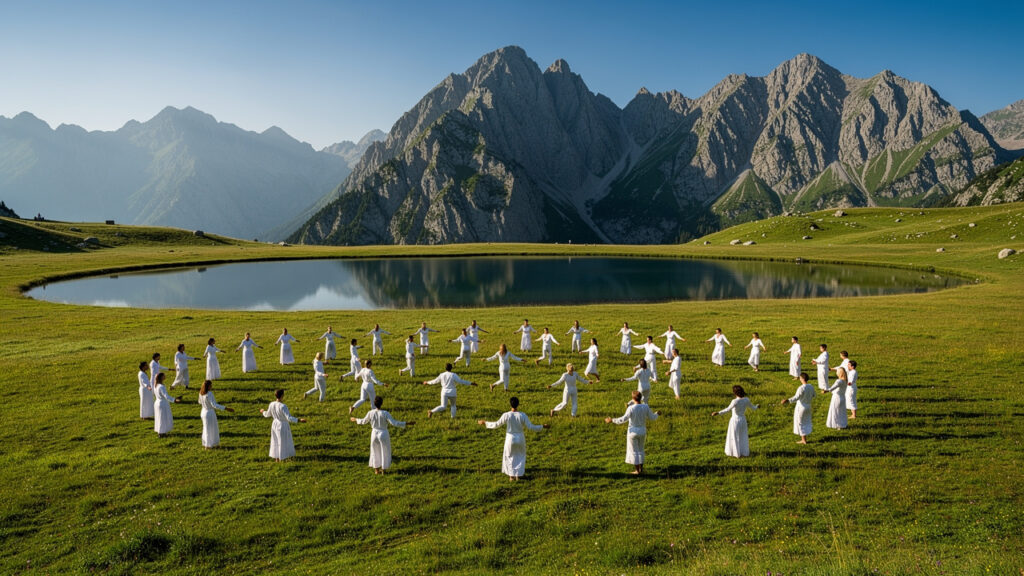
The practice consists of 28 exercises performed in a circle, symbolising eternity and community. The movements are smooth and reflect processes in nature, such as plants growing, birds in flight and the movement of planets. The music, specially composed by the Teacher, is an essential part of the practice, setting its rhythm and mood. As of 2026, paneurhythmy is practised by groups in parks and gardens in many cities in Bulgaria and around the world.
The annual gathering at the Seven Rila Lakes is a striking example of paneurhythmy’s appeal. There, hundreds of people dressed in white perform the dance together in the meadows near the Kidney Lake. The sight is impressive and shows how an individual practice can become a powerful collective ritual for harmony and spiritual uplift.

The Universal White Brotherhood Today
Today, the Universal White Brotherhood exists as a network of communities rather than a centralised organisation with a single leader. After the Teacher Danov’s death and during the years of the communist regime, when the movement was persecuted, it began to revive after 1989. Its focus remains on the Teacher’s talks, music and paneurhythmy. The publishing house Byalo Bratstvo (White Brotherhood) continues to publish his lectures and other related literature.
Organisational structure: Informal communities and associations.
Main event: The summer spiritual gathering in the Rila Mountains (1–21 August).
Funding model: Based on donations and voluntary work; there are no participation fees.
Compatibility: Followers are not required to give up other religious or philosophical beliefs.
For anyone who wants to explore the teaching, the easiest way to start is to find a local group that practises paneurhythmy. In larger cities such as Sofia, Plovdiv, Varna and Burgas, groups meet regularly in parks during the warmer months. They are open to newcomers and are usually happy to help them learn the movements. This is the most authentic way to get a first-hand feel for the community.
Common Misconceptions and Practical Tips
One common misconception is to approach the Universal White Brotherhood expecting quick results or miraculous healing. The teaching is a lifelong path that calls for patience, consistency and, above all, working on yourself. It does not offer ready-made answers, but tools to help each person find their own.
Another pitfall is idealising the Teacher too much and turning him into an idol, which goes against the very spirit of the teaching. Petar Danov repeatedly emphasised that he was only a guide pointing the way, and that each person had to walk it themselves. The focus should be on the principles, not on the person who passed them on.
A practical approach is to start small. Instead of trying to read hundreds of talks at once, choose one and try to put a single piece of advice from it into practice over the course of a week. Rather than striving for perfect paneurhythmy, simply go out into nature and try to feel its rhythm. The real strength of the Universal White Brotherhood lies in putting its ideas into practice, not just in knowing them in theory.
Frequently Asked Questions
What Is the Role of the Byalo Bratstvo Publishing House?
The Byalo Bratstvo (White Brotherhood) publishing house was established to preserve and share the legacy of the Teacher Petar Danov. Its main activity is publishing his thousands of talks, lectures and musical works. It plays a key role in making the teaching available in its authentic form to people seeking spiritual answers today, both in Bulgaria and abroad through translations.
Do I Have to Be a Vegetarian to Be a Follower?
No, it is not compulsory, although it is strongly recommended. The Teacher advised switching to a meat-free diet for ethical and spiritual reasons, as it is considered purer and non-violent. Many followers see vegetarianism as a natural part of the path, but the decision remains a personal choice rather than a formal requirement for taking part in the community.
Are There Fees for Attending Gatherings or Taking Part in Practices?
No. The Universal White Brotherhood is based on voluntary participation and donations. There are no official fees for paneurhythmy, lectures or even the large summer gathering in the Rila Mountains. Organisational costs, food and camp maintenance are covered by voluntary donations, according to each participant’s means.
What Does Wearing White Symbolise?
White clothing, especially during paneurhythmy and other spiritual practices, symbolises purity, light and new beginnings. It is more than a uniform; it is a conscious choice that helps practitioners attune themselves to higher and purer energies. White reflects all the colours of the spectrum and is seen as a symbol of wholeness and divine harmony.
Is the Movement Recognised by the Bulgarian Orthodox Church?
No. The Bulgarian Orthodox Church regards Petar Danov’s teaching as heretical and incompatible with Christian dogma. In 1922, Danov was anathematised and excommunicated from the Church. Although Danov himself viewed his teaching as esoteric Christianity, the two traditions differ fundamentally in their understanding of God, salvation and the role of the Church.