Nestinarstvo is an ancient ritual dance performed on embers in the Strandzha Mountains. It is part of UNESCO’s Intangible Cultural Heritage and combines pagan and Christian elements.
- The authentic ritual is held mainly in the village of Bulgari on June 3 and 4 (according to the old calendar).
- Nestinars dance in a state of trance brought on by specific music and spiritual preparation.
- The official Orthodox Church does not recognize Nestinarstvo and considers it a pagan practice.
- Many performances at resorts are tourist attractions stripped of the ritual meaning of the tradition.
- The ritual was added to UNESCO’s Intangible Cultural Heritage list in 2009.
The key to understanding Nestinarstvo is not the fire, but the state of mind. This is not simply a dance on embers, but a deep ritual connected to a specific community, place – the village of Bulgari in Strandzha, and a specific time of year. The focus is on spiritual preparation and trance, rather than physical endurance, which sets it apart from ordinary attractions.
For Bulgarian travellers in 2026, finding authentic Nestinarstvo is a challenge. The tradition is protected as World Intangible Cultural Heritage by UNESCO, but at the same time it faces the threat of commercialization, which turns it into a spectacle for tourists.
Distinguishing between a sacred ritual and a paid performance is becoming increasingly difficult. The practical reality is that the genuine experience requires planning, respect for the tradition and a journey to the heart of Strandzha, far from the coastal restaurants.
| Characteristic | Authentic Nestinarstvo | Tourist Attraction |
|---|---|---|
| Place and Time | Bulgari village, June 3–4 (St. Constantine and Helena according to the old calendar) | Restaurants and hotels along the Black Sea coast, throughout the season |
| Purpose of the Ritual | Community ritual for health, fertility and connection with ancestors | Entertainment and spectacle for customers |
| Participants | Initiated Nestinars, members of a closed community | Hired performers, often with no connection to the tradition |
| Price and Access | Free, but requires travel and respect for the community | Part of a dinner or entertainment program, costing around €25–50 per person |
What is Nestinarstvo and what is its origin?
Is Nestinarstvo a pagan ritual or a Christian celebration?
It is a syncretic ritual combining ancient pagan practices, probably originating with the Thracians, with the veneration of the Christian saints Constantine and Helena. The Church, however, rejects it as pagan.
Nestinarstvo is a ritual dance performed on live embers by initiated men and women known as Nestinars. At its core, it is a complex religious and social phenomenon, not simply a demonstration of courage. Its origins are shrouded in mystery, but most researchers connect it with ancient Thracian cults of the sun and nature, which later blended with Christianity and adapted to the feast of Saints Constantine and Helena.
This complex history is the reason for its controversial perception. On the one hand, it is deeply connected to the Orthodox calendar, and the icons of the saints are a central element of the ritual. On the other, elements such as trance, dancing on fire and the specific music are foreign to orthodox church practice. The Bulgarian Orthodox Church officially does not recognize the ritual and defines it as a pagan practice.
Official Status: UNESCO Intangible Cultural Heritage
Main Day: June 3 (St. Constantine and Helena according to the old calendar)
Geographical Centre: Bulgari village, Strandzha Mountains
Key Element: A state of trance, rather than physical endurance
Nevertheless, for the small community in Strandzha, Nestinarstvo is the most important day of the year – a time for purification, praying for health and fertility, and maintaining the connection with ancestors and patron saints.
The ritual step by step: From ‘dressing’ the icons to dancing on the embers
What is the connection between Nestinarstvo and Saints Constantine and Helena?
The saints are the patrons of the ritual. Nestinars believe that their icons protect them from the fire and guide them during the dance, while their feast determines the date of the tradition.
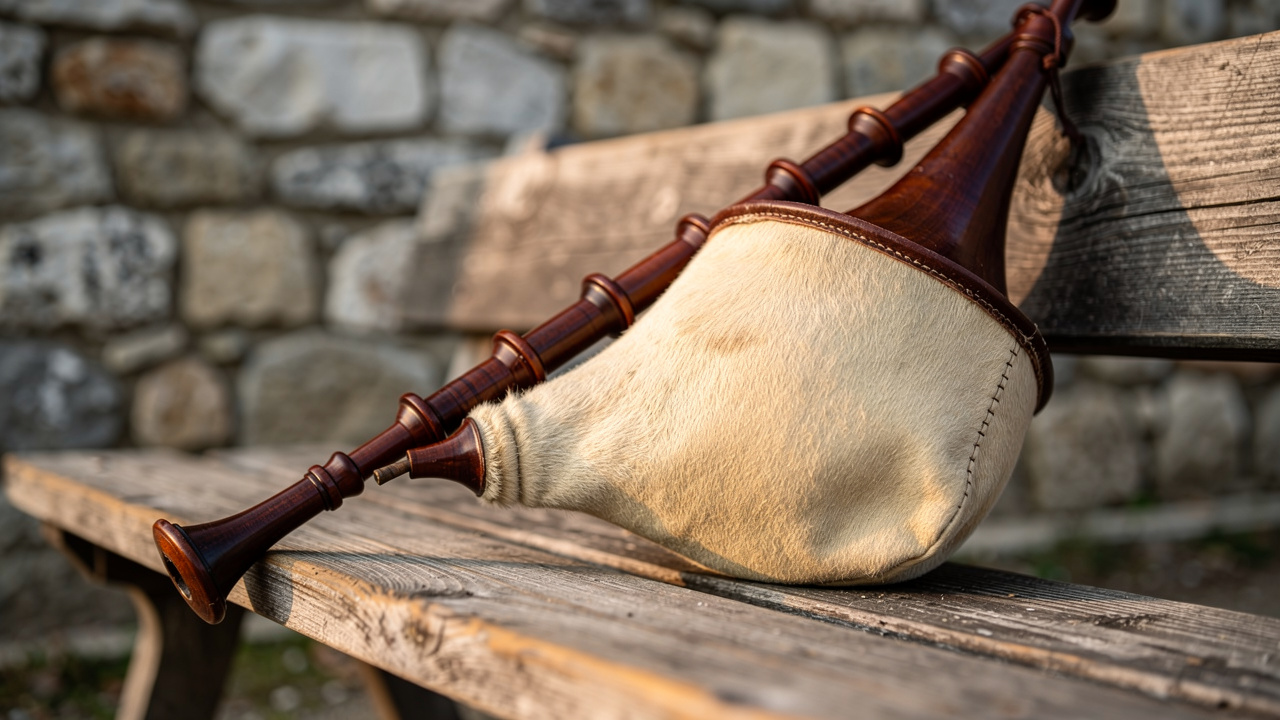
Preparation for the ritual begins days before the actual feast, but the culmination comes on June 3. In the morning, the icons of St. Constantine and Helena are “dressed” in red cloth, decorated with flowers and carried out of a special building called the “konak”. A procession then heads to a sacred spring (ayazmo), where a water-blessing ceremony takes place. The entire day is accompanied by specific music played on a bagpipe and drum – the so-called “nestinarski skopos”, which plays a key role in entering a trance.
The most common mistake made by an outside observer is to think that the dance is a mechanical act. In fact, Nestinars say that they are “taken over” by the spirit of the saint. They enter a state of complete detachment from reality, feel no pain and often make prophecies. This state cannot be achieved at will and is considered divine grace, given only to the chosen.
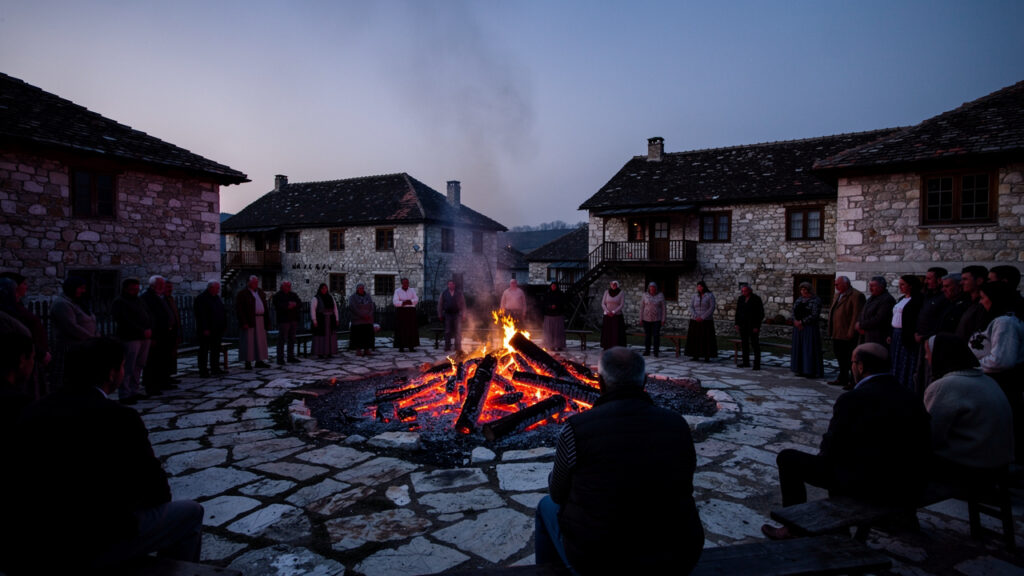
In the evening, a large fire is lit in the village square. When the wood has burned down and turned into a dense carpet of embers, the chief female Nestinar or Nestinar, holding the icon, is the first to enter the circle of fire. The dance consists of small, measured steps, with no visible signs of pain. This is the culmination, symbolizing the triumph of the spirit over matter and purification through fire.
Where and when can we see authentic Nestinarstvo in 2026?
Where in Bulgaria can authentic Nestinarstvo be seen?
The only place where the ritual has been preserved in its authentic form is the village of Bulgari in the Strandzha Mountains, during the feast of Saints Constantine and Helena according to the old calendar.
The main mistake many people make is visiting Bulgari village on May 21 – the date of the feast according to the new church calendar. The community there, however, follows the old calendar, so the actual rituals take place on June 3 and 4. Arriving on the wrong day leads only to disappointment and an empty village square. So, if you are planning a trip in 2026, mark these exact dates on your calendar.
Bulgari village remains the only stronghold of the authentic ritual. Although historical records point to it being practiced in other Strandzha villages such as Kosti and Brodilovo, today the tradition is alive only here. To experience it, you need to plan your trip in advance. Accommodation in the area is limited, and the village fills with thousands of visitors during the feast. It is advisable to book a stay in nearby towns such as Tsarevo or Malko Tarnovo, which are about a 30–40 minute drive away.
Exact Date (2026): June 3 (evening) and June 4
Location: Bulgari village, Tsarevo Municipality
Type of Event: Public, but with the character of a community ritual
Parking Advice: Arrive in the afternoon to find a spot
The specific thing you should do is arrive in the village in the early afternoon on June 3. This will give you time to see the konak, experience the atmosphere of the preparations and find a good spot to watch the evening dance without interfering with the ritual.
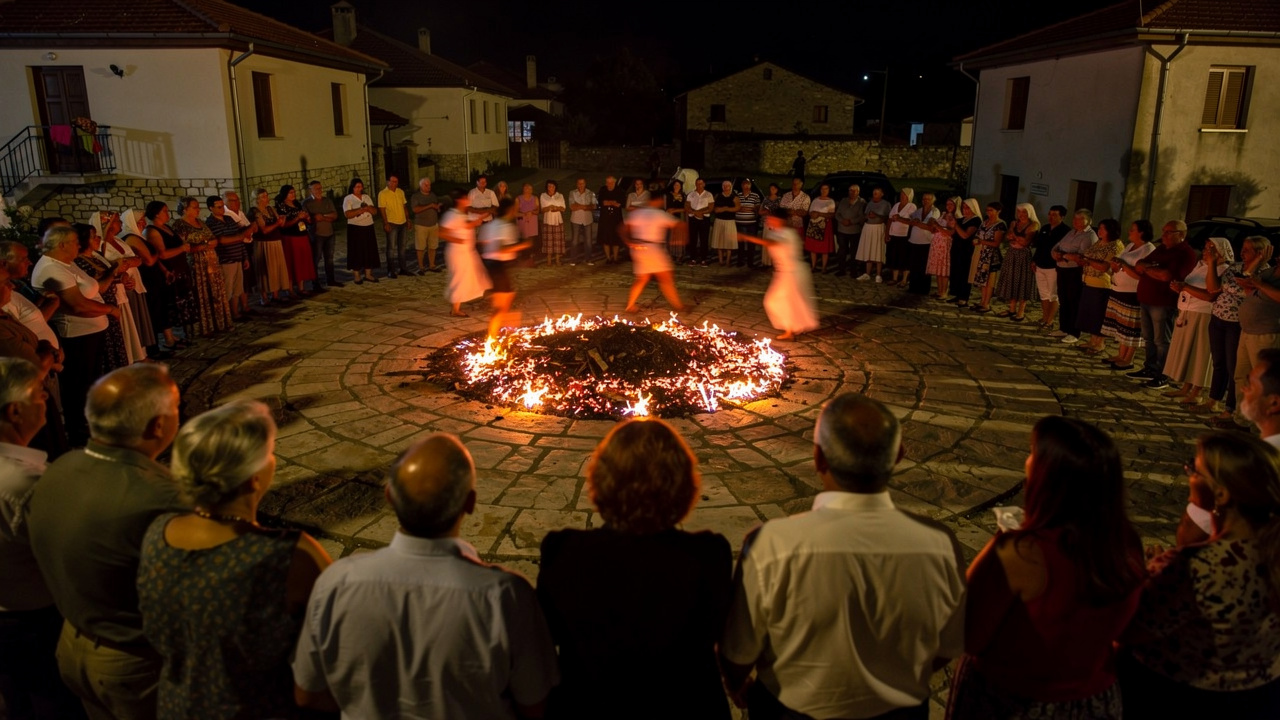
The difference between an authentic ritual and a tourist attraction
An experienced observer recognizes the difference from the context, not from the dance itself. Authentic Nestinarstvo is part of an all-day sequence of rituals, takes place on a specific date and has deep spiritual significance for the community. The tourist version is an isolated 10-minute act performed every evening at a restaurant to impress diners.
An example of the tourist version is a performance at a traditional-style restaurant in Sunny Beach. There, a young man dressed in folk costume briefly dances on a small circle of embers between the tables while waiters carry orders around. The music comes from a sound system, there is no icon, no procession and, above all, no sense of a sacred ritual. It is a job, not a ritual.
In Bulgari village, on the other hand, the entire village takes part. The air is filled with anticipation, the sound of the bagpipe and drum carries throughout the day, and people are there not as spectators at a show, but as participants in an event. The financial aspect is also telling. Access to the ritual in Bulgari is free, while attractions at the resorts are included in the price of dinner, which can reach €40–50.
Choosing a tourist attraction is not necessarily a bad thing if the goal is simply to see the visual spectacle of dancing in fire. But if you are looking for the true vibe and depth of an ancient Bulgarian tradition, the only way is to head to Strandzha. Nestinarstvo there is an experience that stays with you for life.
How to show respect: Practical advice for visitors
Keep quiet during the ritual. This is the most important rule. When the Nestinars enter a trance and begin their dance, comments, loud laughter and phone conversations are completely inappropriate. You are a guest at a ritual that is sacred to the local community, not at a concert.
Flash photography is strictly forbidden. It is extremely distracting and can disrupt the concentration and trance state of the Nestinars, which is not only disrespectful but potentially dangerous for them. If you take photos, do so discreetly and without additional lighting. Do not try to stand in front of the procession or obstruct the participants’ movement just to get a better photo.
Show respect for the sacred places. Do not enter the konak unless you are invited, and do not touch the icons. These are objects of worship, not museum exhibits. If you want to learn more, the best approach is to speak with one of the older local residents before or after the ritual, but not during its active phase. One of the best things you can do is simply observe in silence and try to take in the energy of the place. That way, you will take away much more than just photographs.
Frequently Asked Questions
Is walking on embers dangerous, and how do Nestinars avoid getting burned?
Physically, walking on embers is extremely dangerous and can cause severe burns. Nestinars say they do not get burned because they are in a state of trance and under the protection of St. Constantine. Scientific explanations range from the short contact time with the coals to psychological phenomena, but for the participants in the ritual, this is entirely a spiritual act, not a physical trick.
Does the Bulgarian Orthodox Church recognize Nestinarstvo?
No, the Bulgarian Orthodox Church does not recognize or approve of Nestinarstvo. It defines it as a pagan custom and superstition that contradicts Christian dogma. Although the ritual uses icons and is associated with a Christian feast, elements such as trance and dancing in the fire are considered pagan practices.
What music is played during the Nestinar ritual?
A specific melody called “nestinarski skopos” is played. It is performed on a bagpipe accompanied by a drum. The music has a slow, almost hypnotic rhythm and is believed to be one of the key elements that helps the Nestinars enter a state of trance before entering the fire.
Can anyone become a Nestinar?
No, Nestinarstvo is not a skill that can be learned. According to tradition, the gift is hereditary and is passed down through certain families. It is believed that a person is “taken over” or chosen by the spirit of the saint. Attempts by uninitiated people to imitate the dance in the fire are extremely dangerous and are not part of the authentic tradition.
Is there an entrance fee to watch Nestinarstvo in Bulgari village?
No, there is no entrance fee to watch the authentic ritual in Bulgari village. The event is open to visitors because it is part of the cultural and religious life of the community. Your expenses will only be related to transportation to the village and, if necessary, accommodation in the area. Paid performances are characteristic only of tourist attractions.