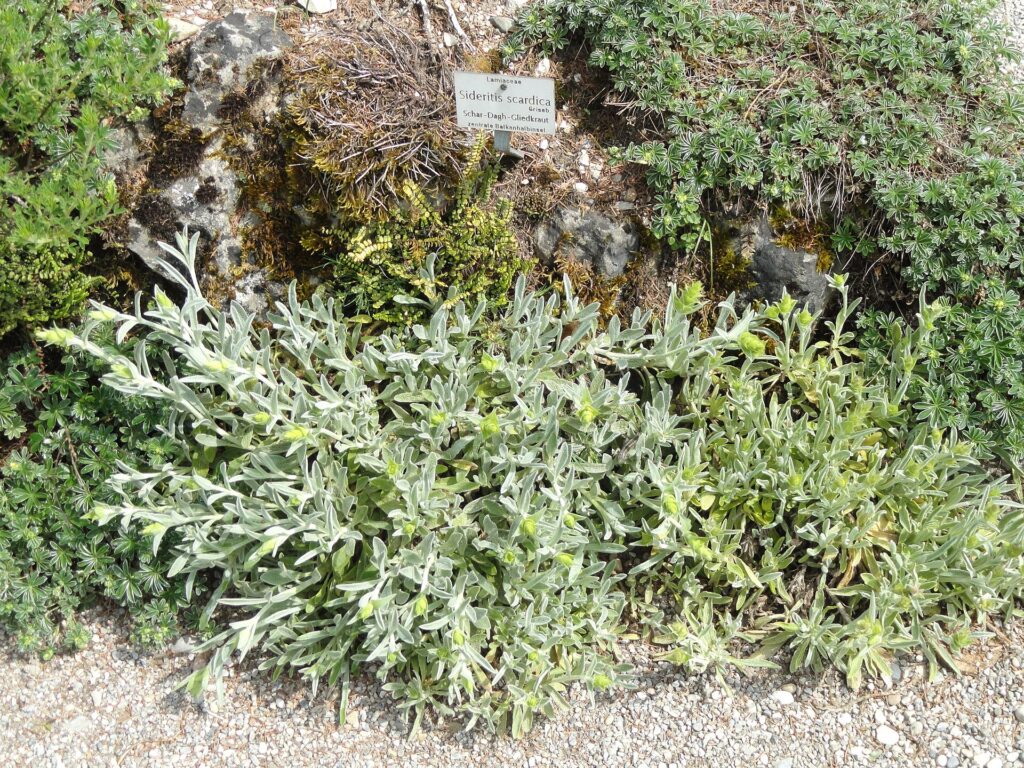
Mursalski tea (Sideritis scardica), also called Pirin tea, Alibotush tea and Greek mountain tea, is a Balkan endemic of the mint family (Lamiaceae). It grows high in Pirin, the Rhodopes and Slavyanka, is listed in the Red Data Book of Bulgaria, and picking it in the wild is banned even for personal use.
- Type: perennial, up to 50 cm tall.
- Where: central and southern Pirin, the Mursalski ridge of the Rhodopes, Rzhana and Slavyanka (Alibotush), at 1400–2200 m.
- Flowers: yellowish, among lemon-yellow papery bracts, in spikes; June – July.
- Status: “endangered” in the Red Data Book; by order of the Ministry of Environment, picking in the wild is banned nationwide, even for personal use.
- Buy only cultivated tea – trading requires a document from a registered farmer.
- Use: a traditional winter tea.
How do you recognise Mursalski tea?
What does Mursalski tea look like?
Mursalski tea is a low plant, up to 50 cm tall. Its yellowish flowers grow in whorls in spike-like clusters, wrapped in lemon-yellow papery bracts that make the whole spike look yellow.
The Latin epithet scardica comes from Scardus, the Latin name of the Šar Mountains, where the species was first described in 1844.
Where does Mursalski tea grow in Bulgaria?
Where does Mursalski tea grow?
Mursalski tea is a Balkan endemic. In Bulgaria it grows in central and southern Pirin, on the Mursalski ridge of the Rhodopes, in Rzhana and in Slavyanka (Alibotush), at 1400–2200 m. Outside Bulgaria it is found in Greece (around Olympus), North Macedonia, Albania and Kosovo.
Its Bulgarian names match the places where it grows: the Mursalski ridge of the Rhodopes, Alibotush (Slavyanka) and Pirin.
Altitude: 1400–2200 m
Mountains: Pirin, the Rhodopes (Mursalski ridge), Rzhana, Slavyanka
Flowering: June – July
Height: up to 50 cm
Part used: the above-ground part, during flowering
Why is picking Mursalski tea banned?
Can I pick Mursalski tea?
No. Under the environment minister’s order for 2025, Mursalski tea is the only one of the 24 banned species for which the ban covers even picking for personal use, across the whole country. The aim is to let its wild populations recover.
Mursalski tea is listed in the Red Data Book of Bulgaria as “endangered”, and on the IUCN Red List as “near threatened”.
So drink only cultivated tea. The plant is easy to grow, including in gardens near its natural range, and thanks to plantations it is sold in pharmacies and shops across the country. Trading it, including at local markets, requires a document from a registered farmer.
Red Data Book of Bulgaria: “endangered”
IUCN: “near threatened”
Picking in the wild: banned, even for personal use (Ministry of Environment order, 2025)
Trade: only with a document from a registered farmer
How is Mursalski tea used?
How do you make Mursalski tea?
Mursalski tea is a traditional winter drink. Bulgarian herbal literature gives three tablespoons of the herb boiled for 3 minutes in 1 litre of water.
It is traditionally used for coughs and colds. The European Medicines Agency has assessed Sideritis herb as a traditional herbal medicinal product.
Frequently asked questions
Is it legal to pick Mursalski tea?
No. Picking it in the wild is banned across Bulgaria, even for personal use.
Where does Mursalski tea grow?
In Pirin, on the Mursalski ridge of the Rhodopes, in Rzhana and in Slavyanka, at 1400–2200 m.
Are Mursalski tea and Pirin tea the same?
Yes. Mursalski, Pirin, Alibotush and Trigrad tea are all names for the same species, Sideritis scardica.
Where can I buy Mursalski tea legally?
Buy cultivated tea in pharmacies and shops. The seller must hold a document from a registered farmer.
What is Mursalski tea called in Bulgarian?
Мурсалски чай (mursalski chay), also пирински and алиботушки чай. Its Latin name is Sideritis scardica.