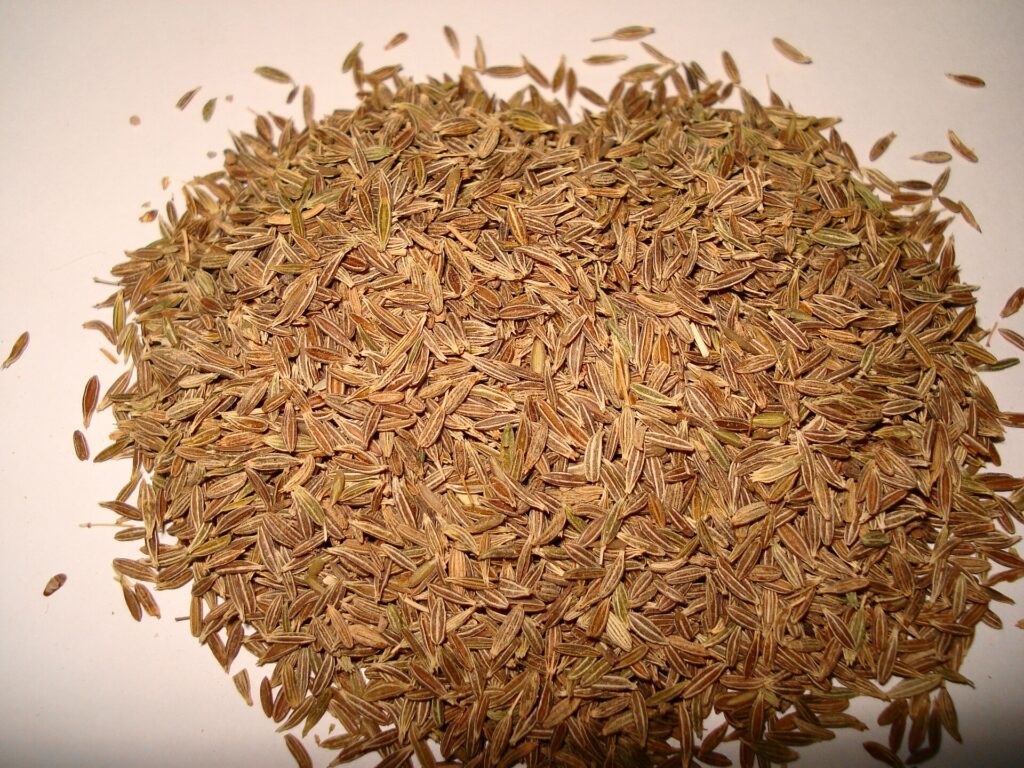
Cumin (Cuminum cyminum), kimion in Bulgarian, is an annual plant of the carrot family (Apiaceae) whose dried fruits are used as a spice. In Bulgarian cooking it is essential to cured meat, sujuk, lukanka and sausages.
- Type: annual herbaceous plant, 30–50 cm tall.
- Parts used: the dried fruits, whole or ground.
- Flavour: bitter and sharp, with a strong warm aroma.
- Not the same as caraway (Carum carvi) or black cumin (Nigella sativa).
- World production: about 70% is in India.
- Status: cultivated; free to grow.
How do you recognise cumin, and what is it confused with?
What is the difference between cumin, caraway and black cumin?
Cumin and caraway are different plants of the same family, while black cumin belongs to another family altogether. Cumin is sharper, paler and larger than caraway. Black cumin is Nigella sativa and is unrelated to them.
| Spice | Latin name | Family | Distinguishing mark |
|---|---|---|---|
| Cumin | Cuminum cyminum | Carrot family | paler, larger, sharper |
| Caraway | Carum carvi | Carrot family | sharp, anise-like aroma |
| Black cumin (nigella) | Nigella sativa | another family | unrelated to cumin |
The plant has a slender branched stem and thread-like leaves 5–10 cm long. The flowers are small, white or pink, in umbels. The fruit is oblong, 4–5 mm, ridged lengthwise and yellow-brown.
Where is cumin grown?
Where does cumin come from?
About 70% of world production is in India, followed by Syria (13%), Turkey (5%), the UAE (3%) and Iran.
Cumin needs a long, hot summer of 3–4 months and is sensitive to frost. It grows best at 25–30 °C. We found no reliable source for commercial cultivation in Bulgaria.
Life cycle: annual
Height: 30–50 cm
Climate: hot and dry, frost-free
Fruit: 4–5 mm, yellow-brown
Parts used: dried fruits
How is cumin used in Bulgarian cooking?
Which Bulgarian foods contain cumin?
Cumin is the characteristic spice of sujuk and lukanka, together with black pepper and salt. It also goes into sausages and cured meat.
Outside Bulgaria it is part of curry powder, garam masala, chili powder and baharat. North Indian cooking often mixes it with ground coriander. It is used whole or ground.
What is the history of cumin?
Seeds of wild cumin were found at the submerged settlement of Atlit-Yam, dated to the early 6th millennium BC. In ancient Egypt it served as a spice and in mummification, and the ancient Greeks kept it on the table in its own container, as we keep pepper today.
Does cumin have proven medicinal effects?
Is cumin a proven remedy?
No. Cumin is used in traditional medicine, but there is no high-quality evidence that it is safe or effective as a treatment.
Frequently asked questions
Are cumin and caraway the same?
No. They are two different species of the carrot family: Cuminum cyminum and Carum carvi.
Is black cumin a kind of cumin?
No. Black cumin is Nigella sativa, which is unrelated to cumin.
What does cumin taste like?
Bitter and sharp, with a strong warm aroma.
Is there cumin in sujuk?
Yes. Cumin is one of the main spices of sujuk and lukanka.
What is cumin called in Bulgarian?
Кимион (kimion). Caraway is ким (kim). The Latin name of cumin is Cuminum cyminum.